I created a short visual essay or guide to understanding the rhetoric of mass media images. Specifically, I wanted to talk about why I think each Trump “assassination attempt” was staged or pre-arranged.
This guide uses two primary sources as a framework: Roland Barthes’s “Rhetoric of the Image” (1977) and Kevin Michael DeLuca’s “Unmoored: The Force of Images as Events” (2008).
Sources
“Alleged Correspondents’ Dinner Gunman Aired…” (2026) from Associated Press & WBNG
“Did Cole Allen Wear an IDF Sweatshirt…” (2026) from Hindustan Times
Note: The original image appears to have been posted to X, but HT seems to be the first news outlet to report on questions pertaining to its veracity.
“Donald Trump Rushed Off Stage…” (2024) from ABC News
“Rhetoric of the Image” (1977) by Roland Barthes
“Trump Assassination Attempt Lays Bare…” (2024) from NPR
“Trump’s Newest Venture? A $60 Bible” (2024) from The New York Times
“Unmoored: The Force of Images as Events” (2008) by Kevin Michael DeLuca
“Usha Vance Appears with WHCD Suspect in 2017 News Clip” (2026) from RogueDNC
“Violence and the Rhetoric of Images” (2003) by Gregory Starrett
Image Descriptions
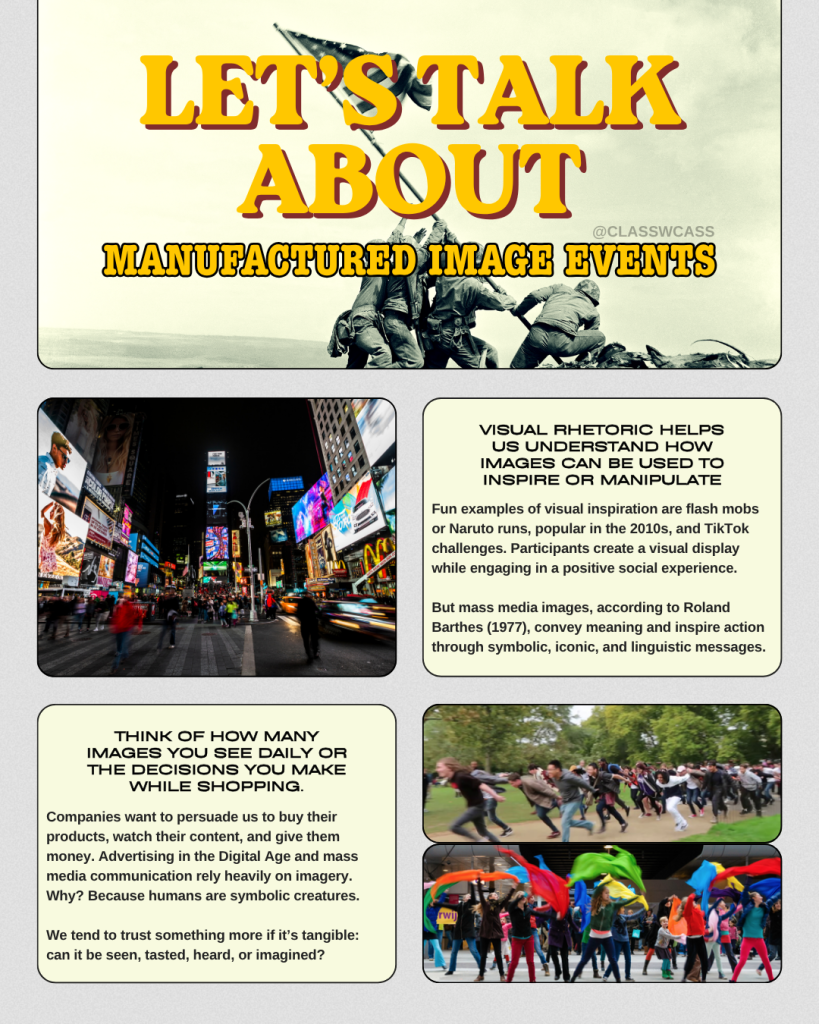
Title Page
Section 1
Visual rhetoric helps us understand how images can be used to inspire or manipulate. Fun examples of visual inspiration are flash mobs or Naruto runs, popular in the 2010s, and TikTok challenges. Participants create a visual display while engaging in a positive social experience.
But mass media images, according to Roland Barthes (1977), convey meaning and inspire action through symbolic, iconic, and linguistic messages.
Section 2
Think of how many images you see daily or the decisions you make while shopping. Companies want to persuade us to buy their products, watch their content, and give them money. Advertising in the Digital Age and mass media communication rely heavily on imagery. Why? Because humans are symbolic creatures.
We tend to trust something more if it’s tangible: can it be seen, tasted, heard, or imagined?
Page 2
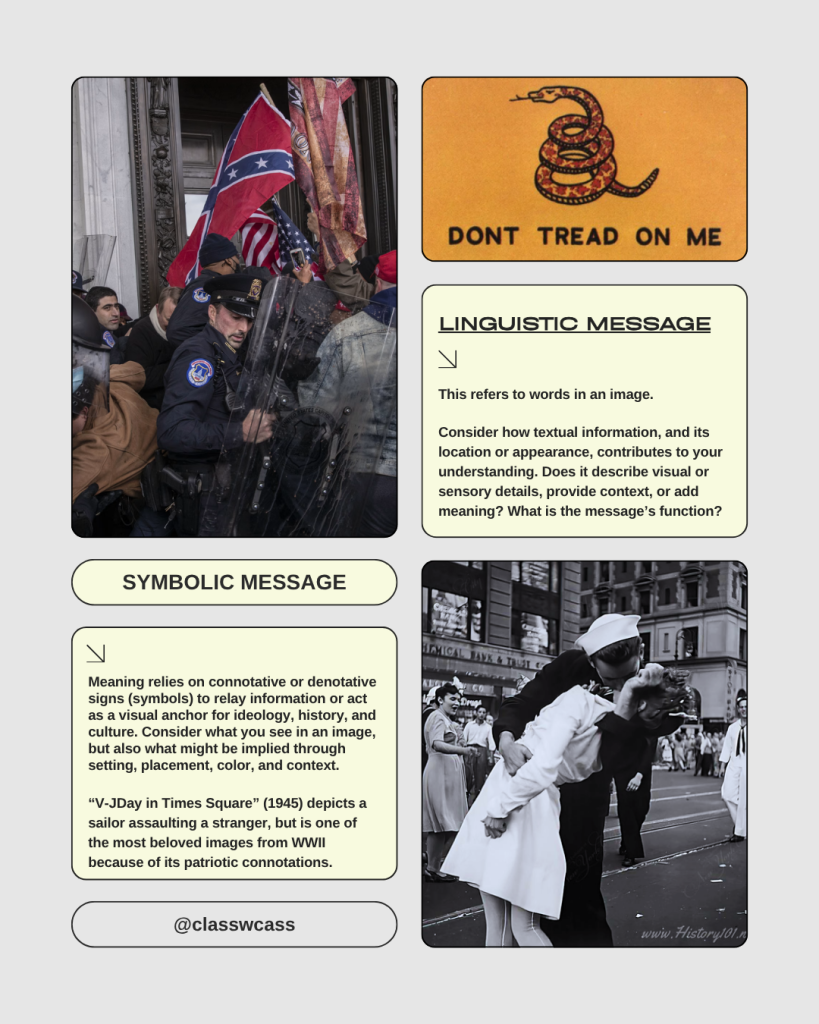
Linguistic Message
This refers to words in an image. Consider how textual information, and its location or appearance, contributes to your understanding.
Does it describe visual or sensory details, provide context, or add meaning? What is the message’s function?
Symbolic Message
Meaning relies on connotative or denotative signs (symbols) to relay information or act as a visual anchor for ideology, history, and culture. Consider what you see in an image, but also what might be implied through setting, placement, color, and context.
“V-JDay in Times Square” (1945) depicts a sailor assaulting a stranger, but is one of the most beloved images from WWII because of its patriotic connotations.
Page 3
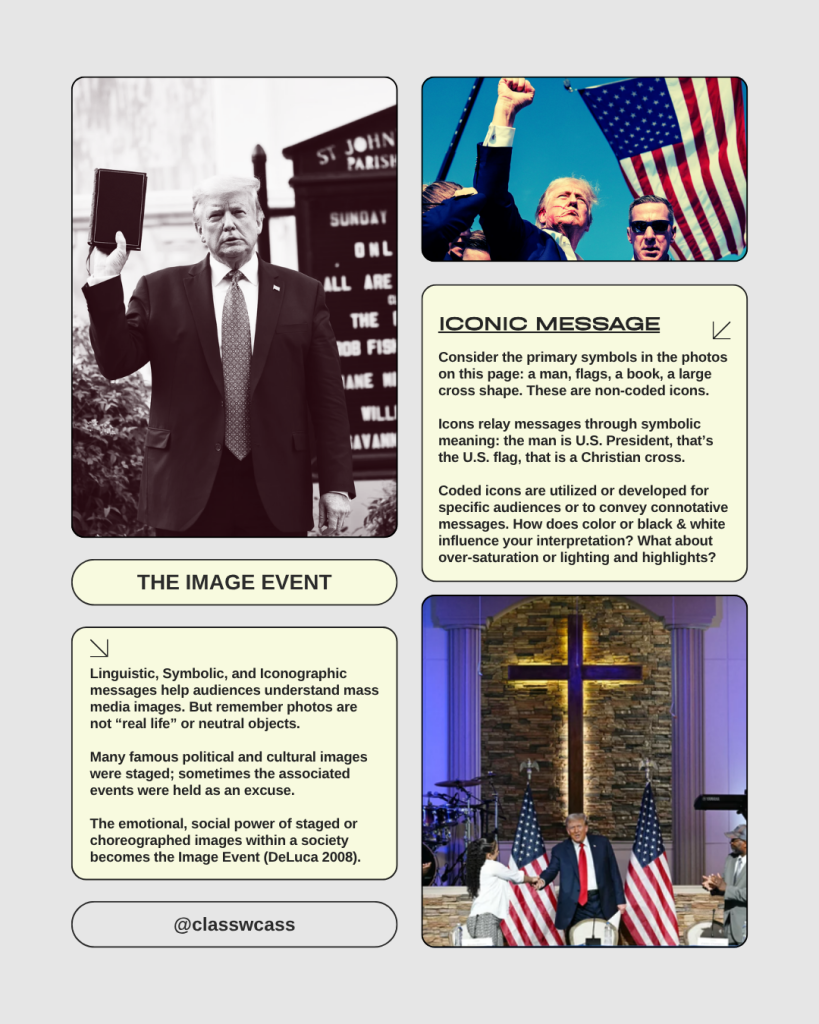
Iconic Message
Consider the primary symbols in the photos on this page: a man, flags, a book, a large cross shape. These are non-coded icons.
Icons relay messages through symbolic meaning: the man is U.S. President, that’s the U.S. flag, that is a Christian cross.
Coded icons are utilized or developed for specific audiences or to convey connotative messages. How does color or black & white influence your interpretation? What about over-saturation or lighting and highlights?
The Image Event
Linguistic, Symbolic, and Iconographic messages help audiences understand mass media images. But remember photos are not “real life” or neutral objects.
Many famous political and cultural images were staged; sometimes the associated events were held as an excuse.
The emotional, social power of staged or choreographed images within a society becomes the Image Event (DeLuca 2008).
Page 4
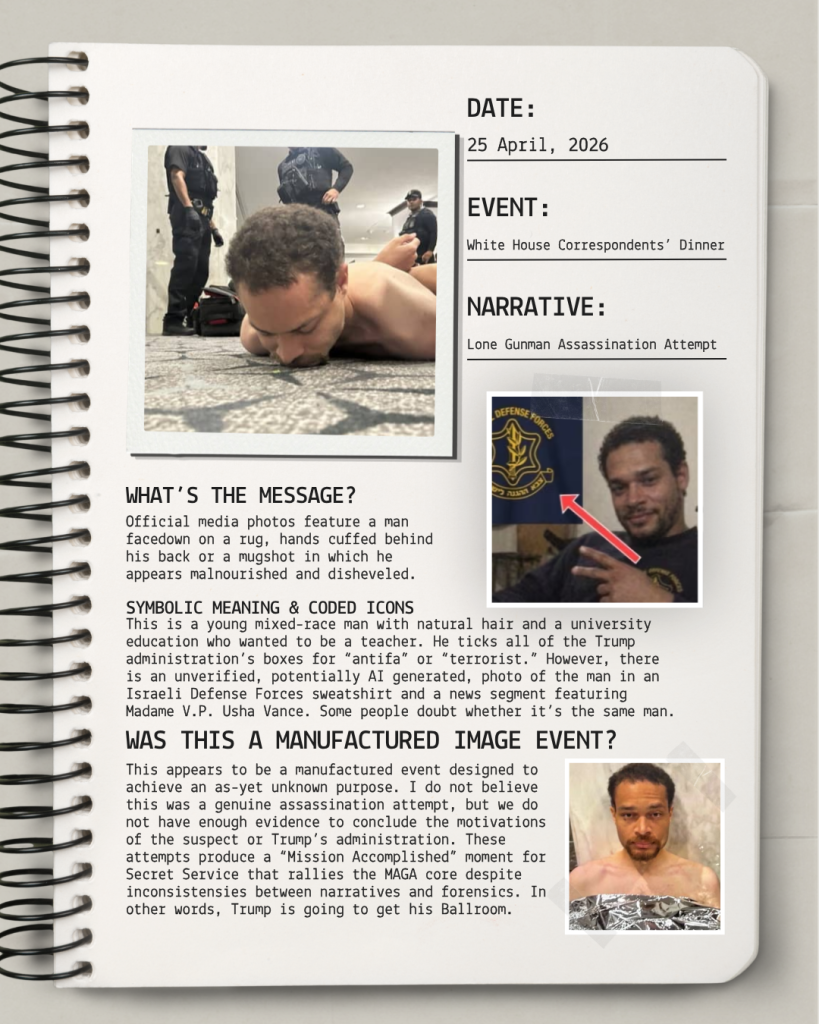
Date: 25 April, 2026
Event: White House Correspondents’ Dinner
Narrative: Lone Gunman Assassination Attempt
What’s the Message?
Official media photos feature a man facedown on a rug, hands cuffed behind his back or a mugshot in which he appears malnourished and disheveled.
Symbolic Meaning & Coded Icons
This is a young mixed-race man with natural hair and a university education who wanted to be a teacher. He ticks all of the Trump administration’s boxes for “antifa” or “terrorist.” However, there is an unverified, potentially AI generated, photo of the man in an Israeli Defense Forces sweatshirt and a news segment featuring Madame V.P. Usha Vance. Some people doubt whether it’s the same man.
Was this a Manufactured Image Event?
This appears to be a manufactured event designed to achieve an as-yet unknown purpose. I do not believe this was a genuine assassination attempt, but we do not have enough evidence to conclude the motivations of the suspect or Trump’s administration. These attempts produce a “Mission Accomplished” moment for Secret Service that rallies the MAGA core despite inconsistencies between narratives and forensics. In other words, Trump is going to get his Ballroom.